The MDCAT is the Medical and Dental College Admission Test. It is the national entry test for MBBS and BDS admission in Pakistan. The Pakistan Medical and Dental Council (PMDC) sets the policy, syllabus and paper format. Five public universities conduct the exam in different regions. See our official sources page for their links and the 2026 dates.
The paper
PMDC has confirmed that the format and syllabus introduced for MDCAT 2025 also govern MDCAT 2026:
| MDCAT 2025 & 2026 | |
|---|---|
| Questions | 180 MCQs |
| Duration | 180 minutes |
| Options per question | 4 |
| Negative marking | None |
| Total marks | 180 (1 per question) |
| Difficulty mix | 15% easy, 70% moderate, 15% difficult |
| Qualifying — MBBS | 55% (99 marks) |
| Qualifying — BDS | 50% (90 marks) |
You have about one minute for each question, with no breaks. There is no negative marking. Answer every question, because a blank answer cannot earn a mark.
Is the MDCAT 180 or 200 questions?
180. The 2023 and 2024 papers had 200 marks. PMDC changed the exam to 180 questions in 2025 and kept this format for 2026. Some old study material still uses 200 questions. Check the date before you use it.
Questions in each subject
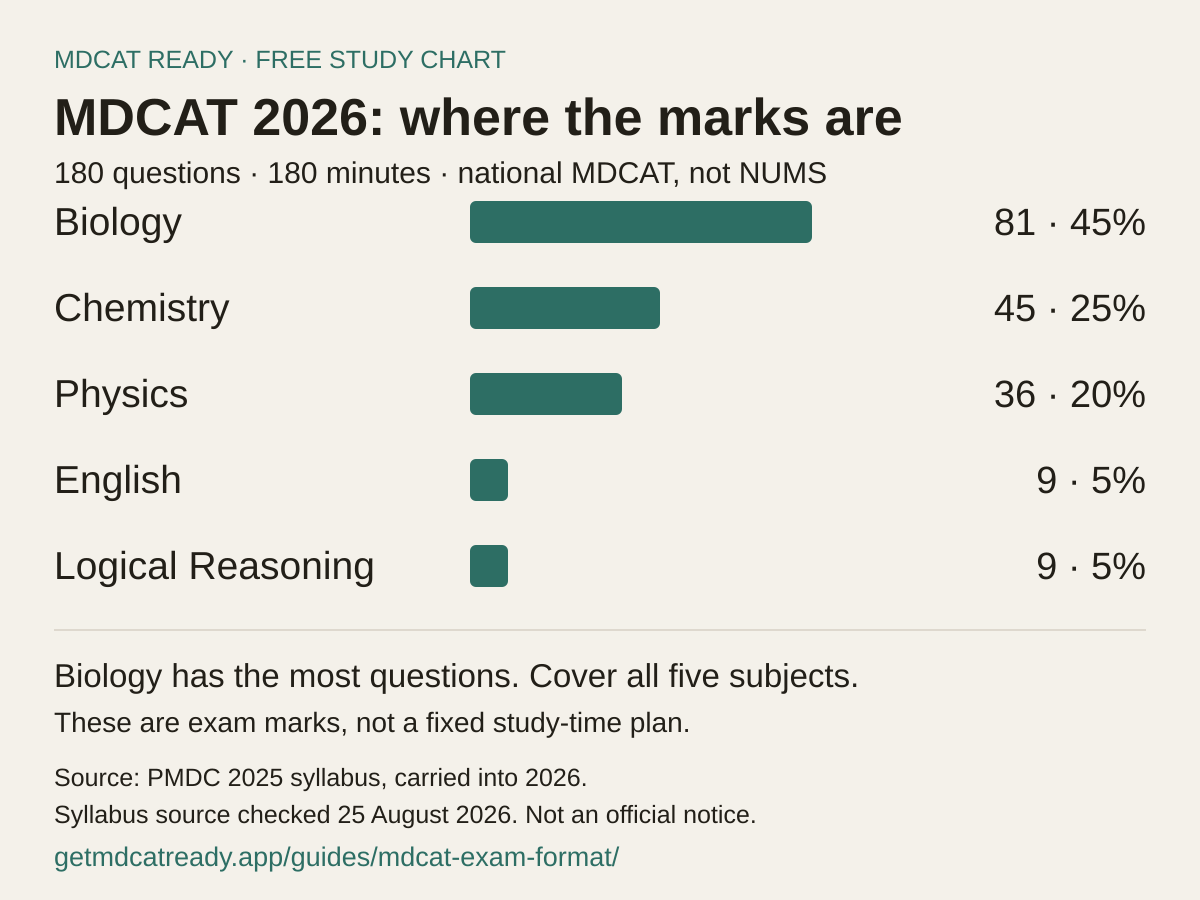
The 180 questions are not spread evenly across subjects:
| Subject | Questions | Share of paper |
|---|---|---|
| Biology | 81 | 45% |
| Chemistry | 45 | 25% |
| Physics | 36 | 20% |
| English | 9 | 5% |
| Logical Reasoning | 9 | 5% |
Biology has the largest share: 81 questions. Physics, English and Logical Reasoning together have 54 questions. Give more study time to subjects with more questions, while still covering all five subjects.
Qualifying is not the same as admission
Scoring 55% meets the MDCAT pass mark for MBBS. Admission also depends on your eligibility, merit position and available seats. The merit formula is 50% MDCAT + 40% HSSC/FSc + 10% Matric. Your MDCAT makes up half of your admission score. In KMU’s 2025 results, more than 23,000 KP students passed the MBBS score. There are far fewer public seats. See our results report for the score ranges.