Start with your own admit card and conducting university’s latest instructions. This page gives a preparation checklist, then the UHS rules for Punjab. Other regions may have different rules.
PMDC moved the national MDCAT from 16 August to 20 September 2026. Some UHS notices still show the old date. PMDC says other arrangements remain unchanged unless a later notice changes them.
Find your official admit-card page →
Before exam day, find your centre and plan your journey. Check the exact campus and entrance. Estimate travel for the exam’s day and time, then allow extra time to arrive before reporting—not when the paper starts.
Before you leave home
Before travelling:
- Check your name, exam centre and booklet or roll details on the admit card.
- Read the reporting time. Allow extra time for travel and finding the entrance.
- Check exactly which original ID your university accepts.
- Pack only the items your university allows.
- Plan where a parent or guardian will collect you after the exam.
- Read any new official notice again before travelling.
If a document or instruction is unclear, contact the university before exam day. An admission application and entry to the exam centre are different processes. A document accepted by one may not be accepted by the other.
Punjab: check your original ID
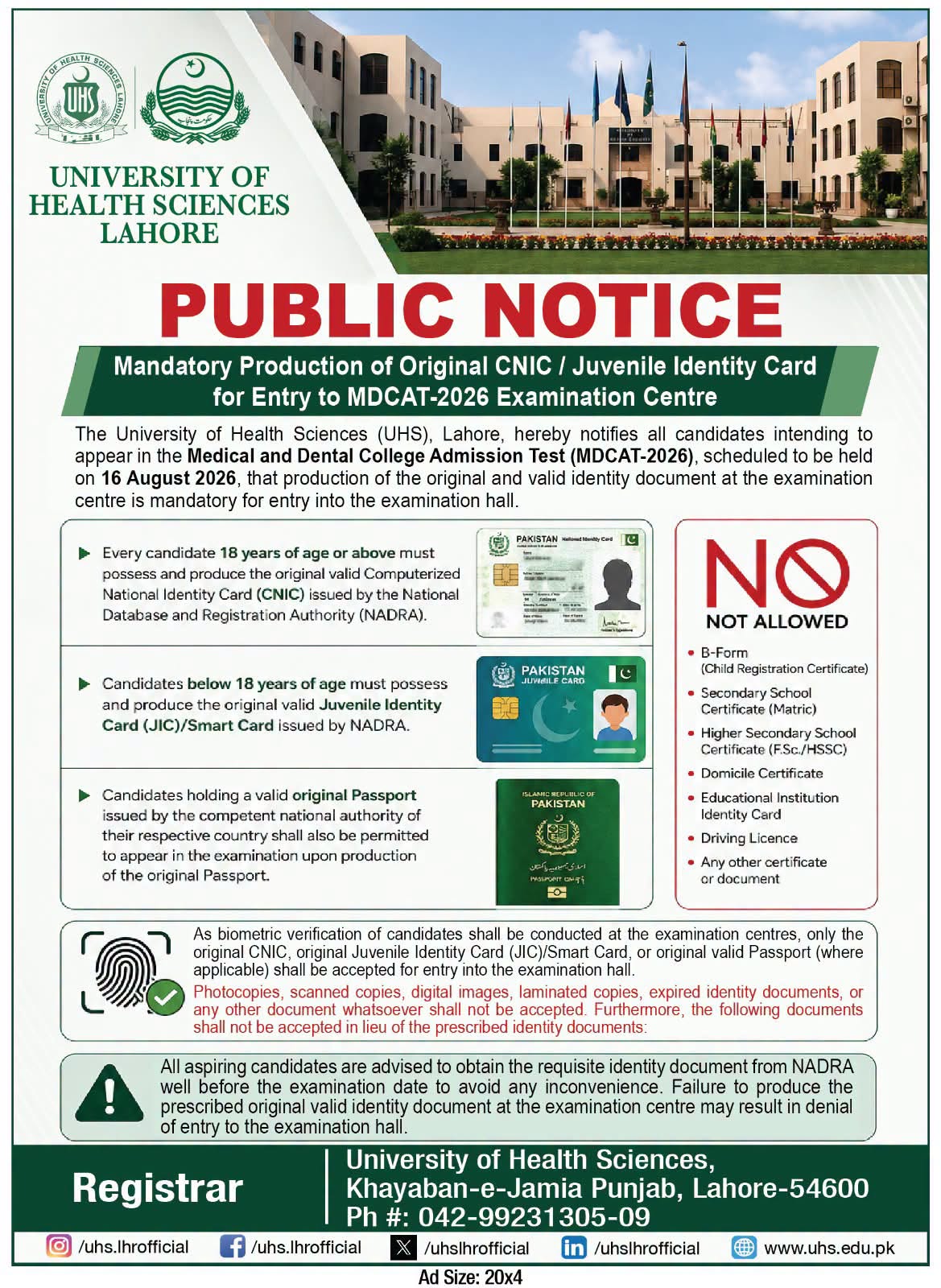
UHS requires a printed admit card and an accepted original, valid ID:
- Age 18 or above: CNIC.
- Under 18: Juvenile Identity Card / Smart Card.
- A valid original passport is also accepted under the notice.
A B-form, school certificate, college ID or driving licence is not a substitute. Photocopies, scans and expired documents are not accepted. Read the UHS identity notice if you are unsure.
Punjab: reporting time and allowed items
The UHS 2026 instructions say:
- The centre opens at 8:00 AM. Report before 9:00 AM.
- There is no entry after 9:00 AM.
- The paper runs from 10:00 AM to 1:00 PM.
- Print the admit card on plain white A4 paper.
- Bring a transparent clipboard, two blue ballpoint pens and a small transparent water bottle.
- Do not bring phones, calculators, books, notes, smart/digital watches or electronic devices.
- UHS does not provide safekeeping for valuables.
Check the latest UHS notices for any change.
Other regions
Do not assume Punjab’s ID, reporting-time or stationery rules apply to you. Use the official university links for your region. The rules printed on your current admit card also matter.
During the paper
Read the instructions on your own answer sheet before marking it. Check that your booklet code and the code on the answer sheet match. Follow the invigilator’s instructions if something is wrong.
For the national MDCAT, see the exam format and marking guide. Do not use another exam’s instructions or an older paper as the rule for your test.
After the exam
Keep any answer-sheet copy that the university allows you to take. When an official key is released, match its year, university and booklet code before checking answers. A provisional key can change after objections.
There is no answer-key or result date on this page. Use our after-MDCAT guide to find official notices. Your own calculation is not the official result.